
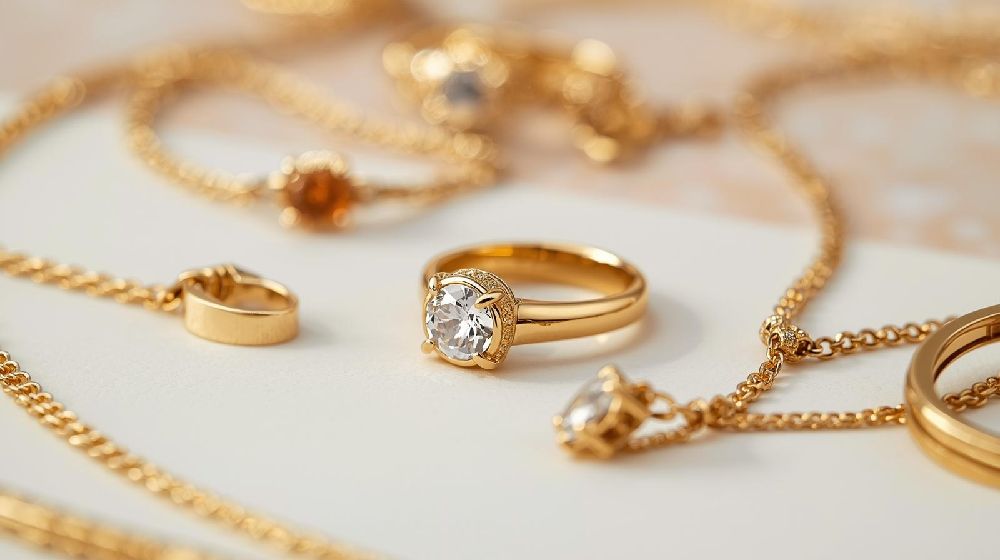
Gold jewelry is admired for its shine, purity, and elegance—but behind every piece is a fascinating science of alloys. Pure gold (24KT) is naturally soft, which makes it unsuitable for complex jewelry designs. That’s why different karats exist—each created by mixing gold with metals like copper, silver, zinc, and nickel.
At DVN Jewelry, understanding alloy science is not optional—it's what shapes our quality, durability, and craftsmanship. This is how different karats perform and why they matter.
1. What Is an Alloy in Jewelry?
An alloy is a blend of pure gold + other strengthening metals.
These added metals:
-
Improve durability
-
Enhance color
-
Increase strength
-
Enable detailed design work
-
Reduce or increase softness
Each karat contains a different percentage of pure gold—changing how the final jewelry behaves.
2. Understanding Karat Levels: Gold Percentage Breakdown
✔ 6KT Gold – 25% Pure Gold
6KT gold contains very little gold, making it extremely hard and durable.
Used mostly in:
-
Fashion jewelry
-
High-strength components
-
Cost-effective jewelry lines
While rarely used for premium gold items, 6KT alloy is excellent for rhodium-based, dual-tone, and plating-friendly designs.
✔ 14KT Gold – 58.3% Pure Gold
One of the strongest gold compositions, perfect for:
-
Everyday wear rings
-
Chains & bracelets
-
Jewelry needing high scratch resistance
Properties:
-
Strong
-
Less likely to bend
-
Holds stones securely
-
Affordable with a rich color
DVN uses 14KT often for designs where strength + elegance is required.
✔ 18KT Gold – 75% Pure Gold
A premium choice globally.
Loved for its balance of durability & elegance.
Properties:
-
Luxurious shine
-
Ideal for diamond settings
-
Suitable for CNC-work and detailed craftsmanship
-
More durable than 22KT
18KT is used in high-end bangles, couple bands, and Western-style designs at DVN.
✔ 22KT Gold – 91.6% Pure Gold
The purest form used in manufacturing.
Popular in India, UAE, and Asia.
Properties:
-
Rich yellow color
-
High purity
-
Soft and bendable
-
Best for traditional & modern Indian jewelry
Because 22KT is softer, only experienced manufacturers like DVN can handle intricate work using:
-
Advanced casting
-
Multi-stage polishing
-
Laser welding
-
Reinforced structural techniques
3. Why Each Karat Performs Differently
a. Strength & Durability
Lower karats = stronger metal
Higher karats = softer metal
6KT ➤ Very strong
14KT ➤ Strong
18KT ➤ Balanced
22KT ➤ Soft & pure
b. Color Tone
More gold = richer yellow
Less gold = lighter or mixed tones
22KT ➤ Deep yellow
18KT ➤ Elegant warm tone
14KT ➤ Light golden white/yellow
6KT ➤ Best for plating & mixed colors
c. Workability in Manufacturing
Not all karats behave the same during:
-
Casting
-
Filing
-
CNC designing
-
Stone setting
-
Polishing
-
Hollow technique
-
Laser welding
22KT requires maximum expertise, while 14KT and 18KT are easier to shape.
4. How DVN Uses Alloy Science to Create Superior Jewelry
At DVN Jewelry, each karat is selected based on design, durability, and customer preference.
✔ For Lightweight & Hollow Designs
→ 18KT & 22KT, engineered with reinforced supports.
✔ For Everyday Wear Chains & Rings
→ 14KT, offering strength + affordability.
✔ For Dual-Tone (Gold + Rhodium) or 6KT Mix
→ Precise alloy calculations ensure brightness and long-lasting plating.
✔ For Traditional Indian Pieces
→ 22KT, enhanced with DVN’s advanced casting to maintain structure.
Every alloy is scientifically tested at DVN for:
-
Density
-
Hardness
-
Purity
-
Color consistency
-
Casting behavior
This ensures every piece meets our high-quality standards.
5. Why Alloy Knowledge Matters to Buyers
Understanding alloy science helps customers choose jewelry based on:
-
Daily wear vs. occasional use
-
Budget
-
Color preference
-
Skin sensitivity
-
Style & design goals
When customers know the difference between 6KT, 14KT, 18KT, and 22KT, they make smarter, long-lasting decisions.
Conclusion
Gold jewelry is more than beauty—it is precision metallurgy.
Each karat behaves differently, and mastering these alloy properties is what makes DVN Jewelry unique. Whether crafting bold bangles, delicate rings, or lightweight everyday pieces, DVN uses alloy science to deliver strength, elegance, and long-term durability.
At DVN, every karat tells a story—and every alloy is designed for excellence.